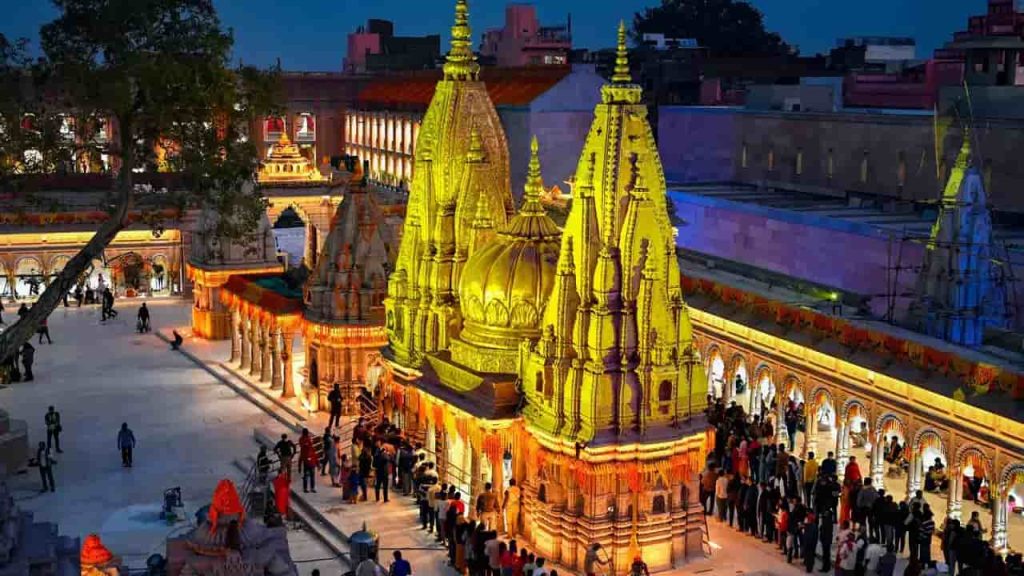
Kashi Vishwanath : The Sacred for the Sacreds
The Kashi Vishwanath story — origins, centuries of destruction and rebuilding, Ahilyabai’s temple, the 2021 corridor — and how to plan darshan, Ganga Aarti, and a yatra.
Of all the sacred sites in the world, few have endured quite what the Kashi Vishwanath Temple has. Razed to the ground more than once across the centuries, rebuilt each time by devoted hands, it now stands — gold-domed — on the western bank of the Ganges, as if history itself tried to extinguish a flame that refused to go out. This is the story of that flame, and a clear-eyed guide to visiting it with Varanasi Darshan Tours.
Before the first stone
Long before any king commissioned a temple, Varanasi — Kashi, the city of light — was already holy ground in Hindu cosmology. The Kashi Khanda of the Skanda Purana describes Kashi as held on the trident of Shiva, with the Vishveshwara Jyotirlinga at its heart: a column of light marking where the Lord of the Universe chose to dwell.
Tradition holds that King Vikramaditya built an early temple here, though the city’s spiritual claim is treated as older than any one foundation. Ancient accounts speak of a shrine with a garbhagriha and pavilions of knowledge, beauty, wealth, and liberation. Pilgrims still come for the same reason: darshan of the Jyotirlinga, then the river.
Kashi is called the forest of bliss and the great cremation ground — the city Shiva does not forsake, where death is spoken of as a crossing, not only an end.
Fire, faith, and rebuilding
The temple’s political history is long and contested in the details; the pattern is not. Shrines on this spot were destroyed and raised again. A widely told sequence runs through the late twelfth century (campaigns in the Gangetic plain and the loss of an earlier Vishwanath), a thirteenth-century rebuilding near Avimukteshwara, later demolitions, Raja Todar Mal’s reconstruction in 1585 under Akbar with pandit Narayana Bhatta’s consecration rites, and the 1669 demolition ordered in Aurangzeb’s reign, after which the Gyanvapi Mosque rose on the older footprint. The Nandi that still faces that direction is pointed out by every guide in the lane.
The temple you enter today is the one Ahilyabai Holkar of Indore built in 1780 on an adjacent plot south of Gyanvapi, with a new Shivalinga installed with Vedic rites. Maharaja Ranjit Singh later gave gold for the domes. In February 2022, a devotee gifted a large gold offering for the sanctum plating. None of that gold is why the queue exists. People come because this is still the Vishwanath of Kashi.
The corridor, and the city it opened
Prime Minister Narendra Modi inaugurated the Kashi Vishwanath Dham Corridor on 13 December 2021. For the first time in living memory the temple precinct connects in a planned way toward the river at Manikarnika. Dozens of smaller shrines that had been buried in the old dense fabric were opened and restored. Daily footfall jumped from a few thousand to crushing peaks on festival days.
The corridor is easier to walk than the old maze. It is also a security zone: bags, phones, and dress rules are real. Budget time. A “quick Vishwanath” between breakfast and a boat is how people miss both.
A day in the temple’s ritual clock
The liturgical day still follows an Agama-rooted cycle. Five aartis structure it. Exact minutes move with sunrise and temple notices — confirm on the morning you go.
- Mangala Aarti — the house of Shiva is woken in the last hours of night; bells and the Rudrashtadhyayi in a dark sanctum.
- Rudrabhishek — Ganga water, milk, ghee, honey, curd, sugar, and sandalwood over the linga while Sri Rudram is chanted.
- Bhog Aarti — mid-morning food offering; bel, marigold, jasmine.
- Saptarishi Aarti — evening; seven priests, big lamps, the chamber full of sound.
- Shayan Aarti — late night; the deity is readied for rest, the veil, the quiet.
The old circuit is still the right one in spirit: bathe or at least touch the Ganga, then walk barefoot to darshan. We can arrange a sunrise boat so the river comes first, then the temple when the queue is human.
Then and now — what actually changed
The soul of the rites did not become a light show. Access did. Rudrabhishek that was once a closed priestly act can be booked by ordinary devotees through official temple channels. Caste bars on the sanctum are not the public rule of this decade; the crush is. A digital Vedic clock in the precinct shows panchang time that priests once kept only on paper. The Pancha-Koshi yatra still exists for those who walk it. The corridor added a straight line to the Ganga that your grandparents did not have.
What has not changed is small and stubborn: a bel leaf, a name of Vishwanath, the belief that this city treats death as a beginning.
How to visit without wasting the day
Go early. Mangala hours are hard but kinder than noon. Carry as little as possible. Follow the locker and phone rules instead of arguing at the scanner. Dress so shoulders and knees are covered; you are in a working temple, not a museum wing. If someone in your group cannot stand in a long indoor queue, split the party — one person sits with bags outside the security line, the rest take darshan.
Do not buy “skip all queues” from a stranger in the gali. Official special puja and Rudrabhishek have counters and receipts. We will tell you honestly what we can facilitate and what only the temple office can sell.
After darshan, drink water and sit. Then either walk the riverfront or rest before evening. Stacking Vishwanath, a full shopping street, and Dashashwamedh Aarti on foot in the same afternoon is how first-timers get ill and angry.
Pair darshan with the river and a proper yatra
Kashi is a river city. The temple is the axis; the Ganga is the body. The evening Ganga Aarti private boat is the right second act for most guests — you see the same faith from the water, without the ghat crush. Read our Aarti timings and booking guide before you choose steps versus boat.
If you are here for Kartik Purnima 2026, that is a different night entirely: Dev Deepawali on 24 November needs its own boat booking.
For more than a flying visit, use a multi-day package so Vishwanath, a heritage walk, and the ghats are paced. Stay close to the river if you can — temple-side hotels beat a one-hour cab to the old city at 4:30 AM.
Book the help you actually need
Varanasi Darshan Tours is a local operator, not a call centre reading a script from another state. We do not sell fake VIP darshan or a closer view of the sanctum for extra money. We will get you to the corridor with time to spare, a boat that exists, and a cab that shows up. For temple logistics plus river and road, start at packages or message +91 9235279147.
काशी विश्वनाथ जय। Har Har Mahadev — in ruin, in gold, and in the ordinary Tuesday queue.
Written by
Varanasi Darshan Tours